

If you’re working with startups, investors, or tech firms in Dubai, you’ve probably heard the phrase NDA thrown around like a business card. But what does it really mean when someone says, “Let me show you the NDA”? It’s not just legal jargon – it’s your first line of defense when sharing ideas, designs, financial projections, or even customer lists. In a city where innovation moves fast and competition is fierce, a solid Non-Disclosure Agreement isn’t optional. It’s essential.
What Exactly Is an NDA?
An NDA, or Non-Disclosure Agreement, is a legally binding contract that prevents one or more parties from sharing confidential information. Think of it like a silent handshake – you tell someone something private, and they promise, in writing, not to repeat it, leak it, or use it for their own gain. Simple? Yes. Powerful? Absolutely.
There are two main types you’ll see in Dubai:
- Unilateral NDA: One party shares info, the other agrees to keep it secret. Common when a startup pitches to an investor.
- Bilateral NDA: Both sides exchange confidential info. Typical in joint ventures or partnerships between companies.
The best NDAs don’t just say “don’t tell anyone.” They define what is confidential, who can know it, how long the secrecy lasts, and what happens if someone breaks it. A vague NDA is worse than no NDA at all – it gives you a false sense of security.
Why Dubai Demands Elite NDA Agencies
Dubai isn’t just another business hub. It’s a melting pot of international startups, multinational corporations, and family-owned empires – all operating under a unique legal framework. The UAE’s commercial laws blend civil code principles with common law flexibility, and local courts interpret confidentiality clauses differently than, say, New York or London.
Most law firms in Dubai offer NDAs. But elite agencies? They specialize in this. They know:
- How to align your NDA with UAE Federal Law No. 5 of 1985 (Civil Transactions Law) and the 2021 Data Protection Law (PDPL).
- Which clauses hold up in Dubai International Financial Centre (DIFC) courts versus mainland courts.
- How to handle cross-border enforcement – critical if your partner is in Singapore, Germany, or California.
One tech founder we worked with signed a standard template from a free zone portal. Two months later, his AI model was copied by a competitor who claimed the NDA didn’t cover “reverse engineering.” The court agreed. Why? Because the agreement never defined “confidential information” with technical specificity. That mistake cost him $2.3 million in lost IP value.
What Elite Dubai Agencies Actually Do
Elite agencies don’t just hand you a PDF. They treat your NDA like a custom suit – tailored to your business, your industry, and your risk profile.
Here’s what you get when you work with them:
- Industry-Specific Definitions: A medical device company needs different protections than a crypto exchange. They’ll define “confidential data” with precision – not just “business plans,” but algorithms, beta test results, sensor calibration logs.
- Enforceable Timeframes: Most NDAs last 2-5 years. Elite firms know when to push for 7 years (for biotech R&D) or make it perpetual (for trade secrets like recipes or proprietary software logic).
- Exit Clauses: What happens if the deal falls apart? Elite NDAs include clear procedures for returning or destroying materials – with audit trails.
- Penalty Structures: Instead of vague “damages to be determined,” they set liquidated damages based on real market impact – say, 30% of projected revenue from the leaked idea.
- Local Enforcement Strategy: They pre-identify which court (DIFC, ADGM, or Dubai Courts) will handle disputes fastest and most fairly.
One agency we’ve seen repeatedly drafts NDAs with embedded digital watermarks and chain-of-custody logs. If a document is shared without authorization, they can trace it – and prove it in court.
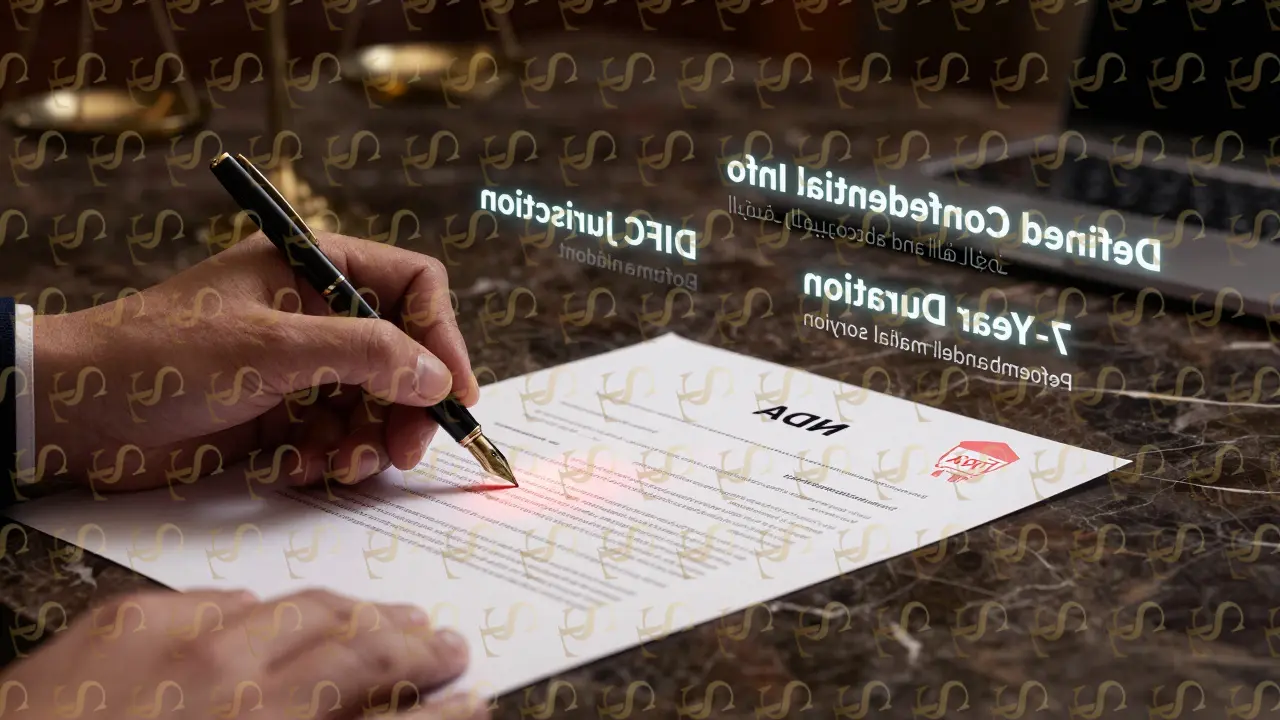
Red Flags in Generic NDA Templates
Free templates from websites? Avoid them. Here’s what goes wrong:
- “Confidential Information” is too broad: “All information shared during meetings” – that’s unenforceable. Courts want specifics.
- No exclusions: What if the info was already public? Or independently developed? Elite NDAs list exceptions clearly.
- One-size-fits-all jurisdiction: Saying “governed by English law” in a Dubai contract? That’s a trap. UAE courts may not recognize it.
- No signature process: Digital signatures must comply with UAE Electronic Transactions and Commerce Law. A scanned PDF isn’t enough.
Another client signed an NDA that didn’t mention subcontractors. Later, their vendor outsourced work to a firm in India. The Indian firm copied the design. The NDA didn’t cover them. No recourse.
How to Choose the Right Agency
Not all “elite” agencies are equal. Here’s how to pick:
- Ask for case studies: Can they show you a recent NDA they drafted that led to a successful injunction or settlement? Real examples, not boilerplate.
- Check their client list: Do they work with companies in your industry? Fintech? Biotech? Luxury goods? Industry-specific experience matters.
- Request a clause-by-clause walkthrough: A good firm won’t rush you. They’ll explain every line – especially the penalties and jurisdiction sections.
- Look for bilingual teams: If you’re dealing with non-Arabic speakers, make sure they have native English (and ideally, Mandarin or Russian) legal drafters on staff.
Top agencies in Dubai often have former judges or DIFC court clerks on retainer. That’s not marketing fluff – it means they know exactly how judges think.

Real-World Scenarios Where NDAs Saved Businesses
In 2024, a Dubai-based AI startup shared its autonomous drone navigation code with a potential manufacturing partner. The NDA, drafted by an elite agency, explicitly listed the neural network architecture, training datasets, and sensor fusion algorithms as confidential. When the partner tried to license the tech to a Chinese firm, the startup sued. The DIFC court granted an emergency injunction – and awarded $1.8 million in damages.
Another case: a luxury perfume brand in Jumeirah shared its scent formula with a packaging designer. The NDA prohibited reverse engineering and required all prototypes to be destroyed after approval. When a competitor launched a near-identical product, forensic analysis traced the leak to the designer’s former employee. The NDA’s audit trail made prosecution possible.
These aren’t Hollywood stories. They happen every month in Dubai. And they all started with a well-crafted NDA.
What Happens If You Skip the NDA?
You might think, “We’re just talking. No one will steal our idea.” But in Dubai, ideas are currency. The moment you reveal proprietary information – even over coffee – you’re at risk.
Without an NDA:
- You have no legal recourse if your idea is copied.
- Investors may walk away – they’ll assume you’re inexperienced.
- Partners will hesitate. They don’t want to be dragged into a dispute.
- Your company’s valuation drops. IP without protection is worth 60-80% less.
One founder told us: “I didn’t sign an NDA with my first investor. He came back six months later with the same product – just rebranded. I lost my company.”
Final Checklist: Before You Sign Any NDA
Use this before you put pen to paper:
- Is “confidential information” clearly defined – with examples?
- Does it specify the duration (not “indefinitely”)?
- Are exclusions listed? (Public info, independently developed, already known)
- Is jurisdiction clearly stated? (DIFC, ADGM, or UAE mainland)
- Does it require written notice before disclosure?
- Are there provisions for returning or destroying materials?
- Is the signature method compliant with UAE law? (e-signature platform certified by TRA)
If even one item is missing, walk away. Don’t sign. Get help.
Can I use a free NDA template from the internet for my Dubai business?
It’s risky. Free templates rarely comply with UAE laws, especially the PDPL and DIFC regulations. Many don’t define confidential information precisely, ignore jurisdiction, or lack enforceable penalties. In Dubai, courts often reject vague agreements. A $50 template could cost you millions if your idea is stolen.
How long should an NDA last in Dubai?
Most NDAs last 2-5 years. But for trade secrets – like proprietary software, chemical formulas, or AI training models – elite agencies often push for 7 years or even indefinite protection, as long as the information remains secret. Courts in DIFC have upheld perpetual NDAs for true trade secrets under Article 10 of the DIFC Trade Secrets Law.
Do I need an NDA if I’m just talking to a friend?
Yes – if what you’re sharing is proprietary. Even casual conversations can lead to leaks. Elite agencies recommend using NDAs even with trusted contacts. A simple one-page agreement signed digitally protects you without straining relationships. Many clients use the same NDA for friends, investors, and vendors – it’s just a matter of context.
Can an NDA be enforced across borders?
Yes – but only if properly drafted. Elite Dubai agencies build NDAs with cross-border enforcement in mind. They include choice-of-law clauses that reference international treaties like the New York Convention. If your partner is in the U.S., EU, or Asia, your NDA must specify which jurisdiction handles disputes and how judgments will be recognized abroad.
What’s the cost of hiring an elite NDA agency in Dubai?
Basic NDA drafting starts at AED 3,500-7,000 ($950-1,900). Elite agencies charge AED 10,000-25,000 ($2,700-6,800), depending on complexity. But compared to the average loss from IP theft – over AED 5 million – it’s one of the cheapest insurance policies you can buy.